a multicultural Research Library
Making multicultural Australia
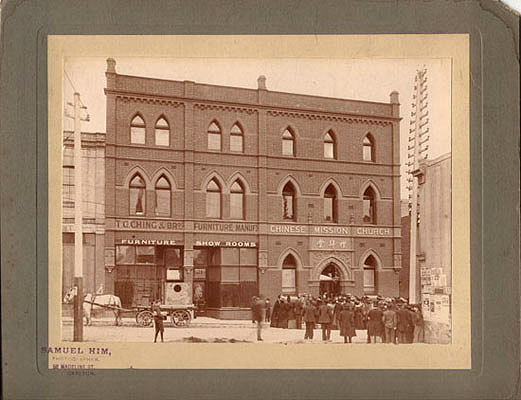
Frontages of successful merchant houses next to Christian churches (Slide 5)
Andrew Jakubowicz.
By the 1890s, the red-brick frontages of successful merchant houses sat side by side with Christian churches, society clubhouses and other 'respectable' premises that gave Little Bourke Street its distinctive late-Victorian solidity and human scale.
Created:
unknown
Date Added:
03 February 2009
Source:
source not available
Format:
jpg (JPEG Image);
File size:
48 KB
Dimensions:
521 x 400
Transcript
By the 1890s, the red-brick frontages of successful merchant houses sat side by side with Christian churches, society clubhouses and other ‘respectable’ premises that gave Little Bourke Street its distinctive late-Victorian solidity and human scale. The fabric of Melbourne’s ‘Chinese Quarter’ was added to and improved from its beginnings in the 1850s to its peak and then decline by the 1920s.
Museum of Chinese Australian History
Item: 2006.01.03; c. 1920s
Photographer Samuel Him, 55 Madeline St, Carlton
View other images on Cultural Studies
 Holocaust Museum - 1
- Guests at the launch of the book (Slide 2)
- Fijian-Indian gardens: replacing lost farmlands - Narendra Singh (5)
- Emilio Russo, man about town in Sydney Road Brunswick, circa 1955.
- Mabel, her father and son Chris
- Sydney Road Brunswick Music Festival 2006 - 8
View other Artworks
- "Epiphany at the Bogie Hole"
- The Petrie Tableau (detail)
- Women
- Drawing by child in detention - 3
- Relationship
- Auburn West Public School (New South Wales) - anti-racism project
Visit the multicultural Library for other documents, video, audio and images.